Why Knowing Two People Changes the Whole Gym
Quick Answer: Being recognised at a gym changes the experience from a performance in front of strangers to something closer to going somewhere familiar. It reduces self-consciousness, adds a small accountability effect, and removes the biggest practical barrier for new members, which is not knowing how anything works. You do not need friends - two people who recognise you is enough, and it takes roughly six weeks of showing up at the same time to get there.
The difference between a gym you dread and a gym you go to is rarely the equipment. It is usually whether walking in feels like arriving somewhere or like being watched.

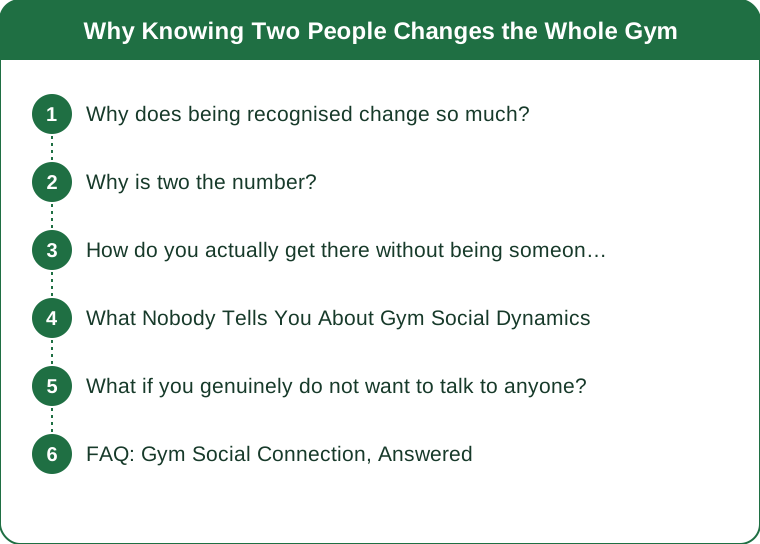
Why does being recognised change so much?
Because most gym self-consciousness comes from feeling anonymous and observed at the same time. People overestimate how much others notice them - the effect is well documented and it is stronger in unfamiliar environments where you have no social position.
Being recognised gives you a position. Once two people nod at you, you are a regular rather than an unknown, and the sense of being evaluated drops sharply.
It also removes the practical barrier nobody talks about. New members frequently do not know how a machine adjusts, where things are kept, or whether a bench is taken. Not knowing who to ask keeps people on the three machines they already understand for months.
And there is a small but real accountability effect. Not the intense kind of a training partner, just the awareness that someone might notice you were not there Wednesday. That is enough to tip a marginal decision on a dark evening.
The evidence on social support and exercise adherence is consistent: it is among the strongest predictors of long-term participation, above programme design and above most measures of initial motivation.
Why is two the number?
Because one is fragile. If the one person you know moves gyms or changes their schedule, your entire social connection to the place disappears in a week.
Two is redundant enough to survive that, and it is low enough to be achievable without being an outgoing person.
Two also crosses a threshold in how you read the room. With zero connections you scan a gym as a room full of strangers. With two, you scan it for the people you know, and everyone else becomes background rather than audience.
More than two is nice and is not necessary. People who describe their gym as friendly usually turn out to know a handful of people by face and perhaps two by name.
And it does not have to be other members. A member of staff who knows your name counts fully, and is often the easiest one to get.
How do you actually get there without being someone who chats?
Go at the same time on the same days. This is 80 percent of it. Recognition is a function of repeated exposure, and it happens on its own if you are consistently in the same room as the same people. Six weeks of a fixed schedule reliably produces face recognition.
Pick a class over the gym floor if you find this hard. Classes have fixed attendance, a shared experience, and a natural excuse for talking to the person next to you. Almost everyone who says they made friends at the gym made them in a class.
Ask one practical question a week. How do you adjust this seat. Is anyone using this. Which of these two machines do you prefer. Practical questions are the lowest-friction social contact available and people answer them warmly almost without exception.
Learn one staff member’s name and use it. Staff are paid to be approachable and they know everything about the building. This is the single easiest connection available and most members never make it.
Arrive five minutes early rather than exactly on time. Almost all incidental gym conversation happens in the five minutes before a class or while waiting for equipment. Arriving exactly on time systematically removes you from every one of those moments.
And nod at people you have seen before. That is genuinely the entire mechanism. Recognition is mutual and someone has to go first.

What Nobody Tells You About Gym Social Dynamics
The people who look most intimidating are usually the most helpful. Experienced lifters are, as a group, notably willing to help and pleased to be asked. The intimidation is a projection; the actual response to a question is almost always generous.
Everyone is more self-conscious than they appear, including the regulars. The person you assume is judging your form is checking their own in the mirror.
Early morning gyms are the friendliest and quietest socially. Small, consistent crowds who see each other daily. Evenings are the busiest and the most anonymous. If social connection is what you are after, the 6am crowd is a much easier room than the 6pm one.
September is the best month of the year to start and the worst month to judge a gym. It is busier and there are more new people, which means more people who also do not know anyone. The person next to you looking uncertain in the third week of September is very likely in exactly your position.
Headphones are a legitimate and slightly costly choice. They are excellent for focus and they signal unavailability. If you want to be recognised, take them out for the first and last five minutes.
And the changing room is where most gym friendships actually start, which is why people who change at home and leave immediately often find a gym socially cold for years.
What if you genuinely do not want to talk to anyone?
That is completely fine, and recognition still helps without conversation. Being nodded at by two people delivers most of the benefit described here. Nobody is required to make friends.
A fixed schedule alone gets you most of the way, because face recognition happens whether or not you speak.
Consider a small gym over a large one. In a gym of 40 regulars you become known passively. In a gym of 2,000 members you can attend for years without ever seeing the same person twice, and that anonymity is exactly what makes some large gyms feel permanently unwelcoming.
Or consider training with one other person once a week and doing everything else alone. That covers the social predictor entirely without changing how you train.
And if a gym is genuinely the wrong environment for you, that is information rather than failure. Home training, outdoor training, and small studios all produce the same physical results, and the best environment is the one you actually enter regularly.
FAQ: Gym Social Connection, Answered
How long until people recognise me?
About six weeks of consistent attendance at the same time. Faster in classes, faster in small gyms, slower in large chain gyms at peak hours.
Is it weird to talk to people at the gym?
Brief practical exchanges are entirely normal and welcome. Extended conversation with someone mid-set is not - the rule is roughly the same as a quiet workplace. Between sets, in the queue, or before a class is the right timing.
I moved gyms and lost all of this. Is that why I stopped going?
Quite possibly, and it is one of the most under-recognised reasons people fall off after a move. Rebuilding takes about the same six weeks, and knowing that in advance makes the empty first month much easier to sit through.
Does an online community count?
Partially. It provides accountability and support, but not the practical help or the sense of belonging to a physical place. It works best alongside rather than instead of.
This is general guidance. If gym anxiety is severe or stopping you attending altogether, that is worth talking to someone about rather than pushing through.
TL;DR:
- Social connection is one of the strongest predictors of still training in six months - stronger than programme design or initial motivation.
- Two people who recognise you is enough, and it takes about six weeks of attending at the same time on the same days.
- Classes, arriving five minutes early, one practical question a week, and learning a staff member’s name are the low-effort routes.
- September is the easiest month to do this, because everyone around you is also new.
You do not need gym friends. You need two people who nod, and the whole room stops feeling like an audience.
See It in Motion
Seen here: High Waist Embossed Yoga Leggings with Side Pockets — shop it on bubblelime.com
Keep Reading
This article is for general informational purposes only and is not medical advice. It is not a substitute for professional diagnosis or treatment. Always consult a qualified healthcare provider about your individual situation, especially before making significant changes to your diet or exercise routine.