Why the Back Row of a Fitness Class Is the Hardest Place to Learn
Quick Answer: The back row feels safest because nobody is behind you, but it is the worst place to actually learn: you see the instructor through a forest of moving bodies, you get almost no individual correction, and your entire field of view is other people to compare yourself against. The genuinely comfortable spot for a nervous beginner is the second row at the side — good sightline, close enough to be corrected, and nothing in your visual field except the instructor.
Everybody picks the back. It is the obvious choice when you are new, and the reasoning is airtight: fewer people can see you.
Then six weeks in, you are still not sure whether your form is right, still copying the person in front, and still feeling like everyone else has something you missed.
The room chose that for you.
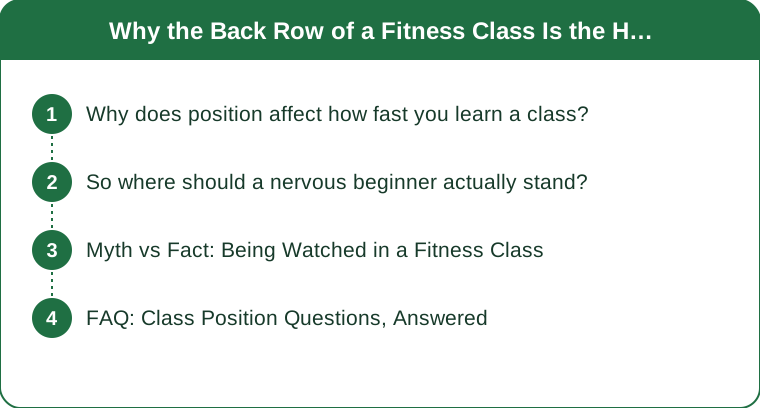
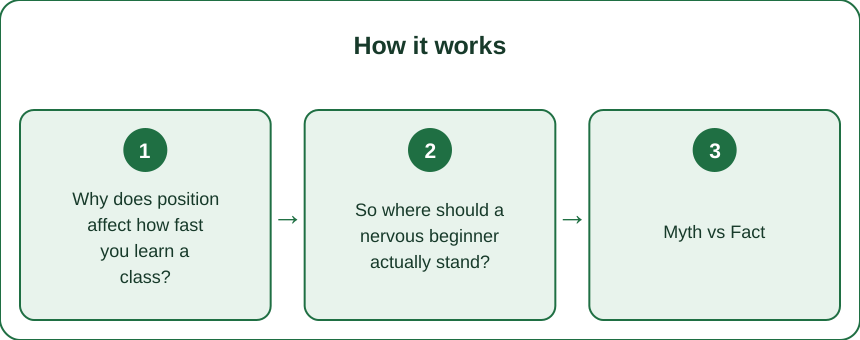
Why does position affect how fast you learn a class?
Three reasons, and they compound.
Sightline. From the back row you are not watching the instructor. You are watching a gap between two people that intermittently contains the instructor. Every time the person in front changes position, your reference disappears. Beginners rely much more heavily on continuous visual reference than experienced participants, who can work from cues alone — so the person who most needs to see clearly has the worst view in the room.
Correction rate. Instructors move through a room in predictable patterns, and they spend most of their floor time in the front two-thirds. This is not favouritism; it is where the sound carries, where they can still be seen by everyone, and where the mirror lets them monitor the whole room. If you are in the back corner, you might get looked at properly twice in a fifty-minute class.
Comparison load. This is the one nobody mentions. From the back row, every single person in the room is in your field of view. You cannot look forward without processing thirty other bodies doing the thing you are unsure about. From the front, your visual field contains the instructor and a wall. The back row is the maximum-comparison seat in the room, which is a strange outcome for the position chosen to reduce self-consciousness.
Put together: worst view, least feedback, most social input. It is a difficult place to improve from, and the difficulty is invisible because it feels comfortable.
So where should a nervous beginner actually stand?
Second row, toward one side. This is the answer for most rooms and most people.
Here is what it gets you. A clear sightline — one row of people, and you can offset yourself into the gap between two of them. Instructor proximity — you are within the zone they naturally work in, so you get corrected without asking. A narrow comparison field — the people ahead are visible, the thirty behind are not, which removes most of the social load. And an edge, meaning there is a wall or open floor on one side, which almost everyone finds settling.
The variants worth knowing:
If the room has a mirror, side positions are better than centre, because a centre position puts your own reflection directly in front of you for fifty minutes and beginners consistently report that as the hardest part.
If it is a cycle or rowing class, position matters less for learning form but more for temperature and sound. Middle of the room, off the aisle, avoids both the door draught and the speaker.
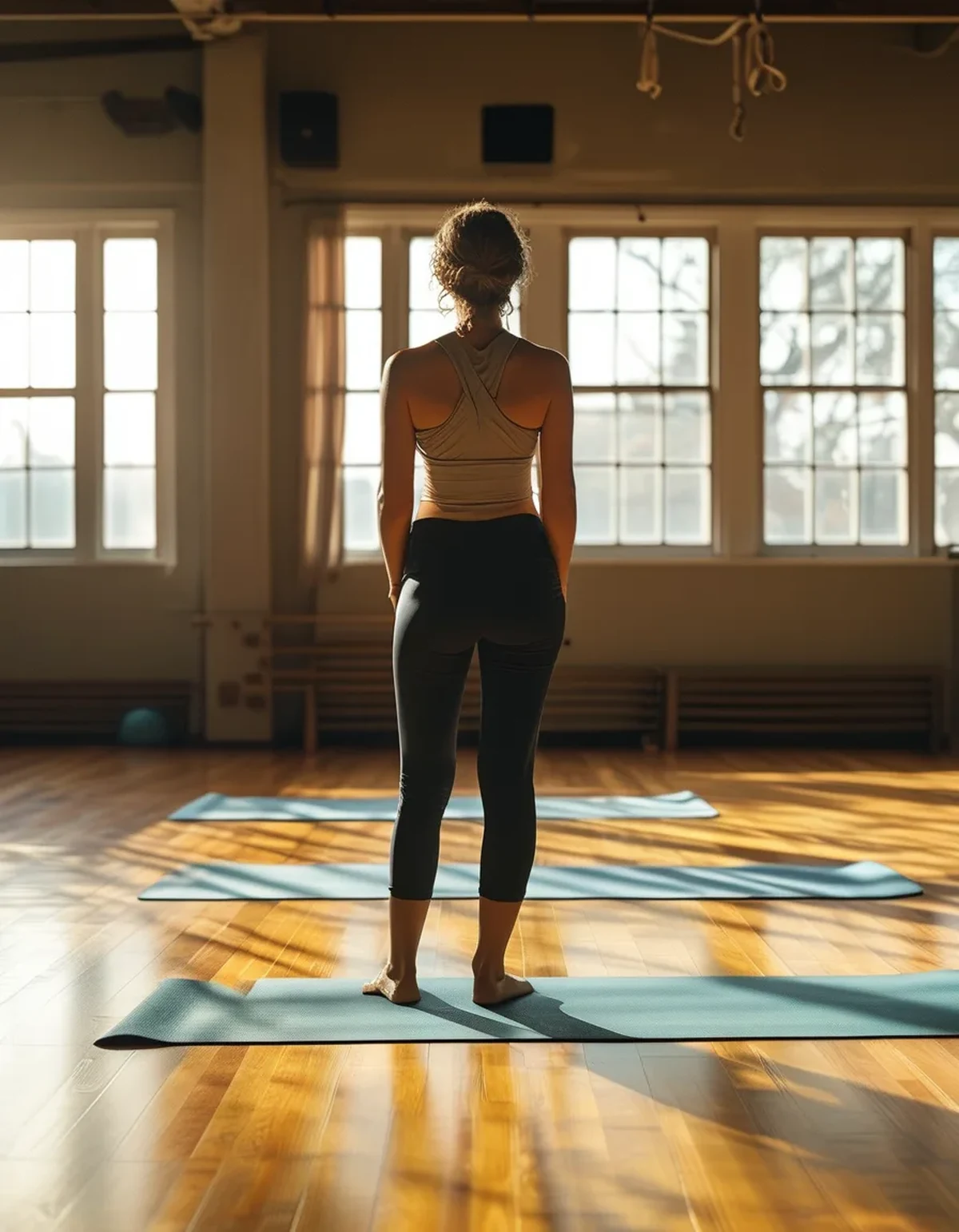
If it is a mat class — Pilates, yoga, floor-based strength — the front row is genuinely the best place. Almost everything happens at floor level, and from the second row back you spend the class trying to see a person lying down behind other people lying down. This is the room where the conventional wisdom fails hardest.
If you truly cannot face moving forward yet, take the back row but stand at the end of it rather than the middle. That single change removes half the comparison field and puts you where the instructor passes when they walk the perimeter.

Myth vs Fact: Being Watched in a Fitness Class
Myth: Everyone notices the new person. Fact: In a class of thirty, most participants are watching the instructor, the clock, or their own reflection. The person genuinely tracking you is the instructor, and that is their job rather than judgement. Being noticed by the instructor is the thing you actually want.
Myth: The front row is for the advanced people. Fact: The front row is for whoever arrived early. In most classes it fills last, which means it is frequently the emptiest part of the room — the opposite of a competitive space.
Myth: If you get a correction, you did something badly wrong. Fact: Instructors correct the people they can see and the people who are close. A correction is a proximity signal far more often than a severity signal, and getting three of them means you were reachable, not that you were worse.
Myth: You should be able to follow along without watching anyone. Fact: Nobody does this for the first several weeks. Copying is how movement is learned, and the entire argument for moving forward is that it lets you copy the right person rather than the person in front of you who is also improvising.
Myth: Everyone else knew what they were doing on day one. Fact: The confident-looking person two mats over has been coming for eleven months. You are comparing your first week to their eleventh month, and the back row gives you thirty simultaneous versions of that comparison to make.
FAQ: Class Position Questions, Answered
What if the spot I want is always taken?
Arrive six to eight minutes early rather than one minute early. Class positions are claimed in the last three minutes before the start, and turning up in that window is what forces you to the back regardless of preference. This one change solves the problem for most people.
Is it rude to move spots partway through a course of classes?
Not at all, and instructors generally read it as a good sign. If it feels awkward to move a long way at once, move one row per week. Four weeks takes you from the back to the second row without a single visible decision.
What if I genuinely do not want to be corrected yet?
Say so before the class rather than positioning to avoid it. Something as brief as saying you are new and would rather just follow along today is normal, and every instructor has heard it. That gets you a good position and the pace you want, which the back row cannot give you together.
TL;DR:
- The back row gives you the worst sightline, the least correction and the most comparison — the opposite of what a beginner needs.
- Second row, toward the side is the best general position: clear view, within the instructor’s working zone, narrow comparison field.
- For mat-based classes the front row genuinely wins, because everything happens at floor level.
- If you cannot move forward yet, take the end of the back row rather than the middle, and arrive six to eight minutes early.
- A correction usually means you were reachable, not that you were doing badly.
The room is not neutral. Choosing where to stand is the cheapest change available to you, and it is worth more in the first month than almost anything else you could do.
See It in Motion
Seen here: Super High Waist Embossed Yoga Leggings with Inner Pocket — shop it on bubblelime.com
Keep Reading
This article is for general informational purposes only and is not medical advice. It is not a substitute for professional diagnosis or treatment. Always consult a qualified healthcare provider about your individual situation, especially before making significant changes to your diet or exercise routine.