How to Stop Comparing Yourself at the Gym
You walk in feeling pretty good about the workout you planned. Then you clock the woman on the rack next to you lifting what you’d consider a good year from now, and the guy on the treadmill holding a pace you couldn’t hold for ninety seconds.
By set two you’re not doing your workout anymore. You’re doing a comparison, and losing.
Quick Answer: Comparison at the gym takes your attention off how movement feels and puts it on how you rank, which is where the enjoyment drains out. Three things actually help: compete only against your own past self using a written log, curate the social media that primes you before you arrive, and reconnect with the specific reason you started. The people you’re comparing yourself to have different bodies, histories, and training ages — the comparison isn’t just unhelpful, it’s not measuring anything real.

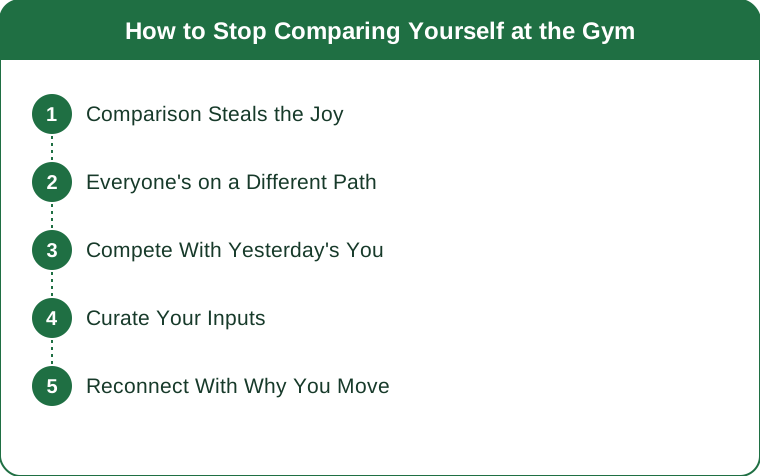
Why Does Comparing Yourself at the Gym Feel So Bad?
Because it quietly changes what you’re doing there.
When you’re focused on the movement — the weight in your hands, your breathing, the count — you’re doing a workout. When you’re focused on where you rank, you’re doing an evaluation, and one you’re guaranteed to lose, because there is always someone stronger, faster, or more at ease in the room. That’s not a personal failing; that’s just what happens in a space with a hundred people in it.
Two things make gym comparison specifically distorted:
You’re comparing your beginning to someone else’s middle. The person lifting comfortably next to you may have five years on you. You’re seeing their present and your present as though they’re the same measurement, when what you’re actually looking at is a snapshot from a much later chapter of a different story.
You can’t see any of the inputs. You can see their weight on the bar. You can’t see their training age, their sleep, their injury history, their genetics, their job, whether they have kids, or whether they were an athlete at nineteen. You’re comparing one visible output while blind to every variable that produced it. As measurement goes, it’s meaningless.
And here’s the loop that makes it self-reinforcing: comparison makes the gym feel unpleasant, unpleasant things get avoided, and avoiding the gym removes the only thing that actually produces progress. The comparison doesn’t just feel bad — it directly costs you the results you were comparing about.
How Do You Actually Stop Comparing Yourself?
Give your attention somewhere concrete to go. “Stop comparing” doesn’t work as an instruction; replacing the comparison does.
Keep a written log. This is the single most effective intervention, and it’s practical rather than philosophical. Write down every set, weight, and rep. Now you have a real number to beat — last week’s number — and it’s sitting in your hand where the other person’s isn’t.
The log does something a mindset shift can’t: it makes your own progress visible. Most people genuinely underestimate how much they’ve improved, because improvement is gradual and memory is terrible at gradual. Flipping back three months and seeing that your working weight has gone up 40% is a fact, not a reassurance.
Have a plan before you walk in. Deciding what to do while standing on the gym floor leaves a lot of attention free to wander onto other people. Three or four exercises written on your phone gives your focus somewhere to be.
Use headphones deliberately. Not to hide — to narrow your attention to your own set. It works.
Pick a genuinely non-comparative metric. How many sessions you completed this month. Whether you added 2.5kg. How you felt at rep eight. These are things you control, which is the whole point — you can’t control being stronger than a stranger, so it’s a terrible goal.
Go off-peak while you’re building the habit. A quieter floor has fewer comparisons available. This isn’t avoidance; it’s stacking the deck while a new habit is fragile.

What Nobody Tells You About Gym Comparison
The comparison usually starts before you arrive. Thirty minutes of fitness content on your phone primes you to evaluate rather than participate, and you carry that in the door. If certain accounts consistently leave you feeling worse, mute or unfollow them — no guilt required, and no need to justify it to anyone. This is genuinely one of the highest-leverage changes available, because it’s the input that shapes your default frame before the gym even happens.
Everyone else feels it too, including the people you’re comparing yourself to. Survey gym-goers and you’ll consistently find that most report feeling self-conscious and worried about judgment, while almost nobody reports actually judging others. The strong person you’re measuring yourself against is very likely measuring themselves against someone else. It’s comparison all the way up, and nobody at any level reports feeling like they’ve arrived.
Beginners improve fastest. There’s a real phenomenon here — early training progress is quick, and the advanced lifter next to you may be grinding for a fraction of the gain per month that you’re making. You’re on the steepest part of a curve they left years ago.
Comparison sometimes contains useful information. Occasionally what you feel isn’t inadequacy but interest — “I’d like to be able to do that.” That’s a goal, and it’s fine. The test is what it produces: a specific thing to work toward is useful, a vague sense of falling short isn’t.
Anchoring to a reason works better than anchoring to a number. Energy, stress relief, sleeping better, being able to carry things, feeling capable in your body. None of those are competitive quantities. When comparison creeps in, the fastest exit is a specific question: did this session serve the reason I’m here? Usually yes, regardless of what anyone else lifted.
And a note worth making: if comparison at the gym has tipped into something heavier — persistent distress about your body, exercise that feels compulsory rather than chosen, or anxiety that keeps you away entirely — that’s worth talking to a professional about. It’s common, it’s treatable, and it isn’t something to sort out alone with better self-talk.
FAQ
Is it normal to feel intimidated at the gym?
Extremely. Surveys consistently find that a large majority of gym-goers report feeling self-conscious, including experienced ones — everyone in the room believes they’re the one being observed while almost nobody is actually observing. It tends to ease substantially after a few weeks in the same space, as the environment stops registering as unfamiliar.
How do I stop comparing my body to others at the gym?
Shift what you’re measuring. Track performance rather than appearance — weight lifted, sessions completed, how a movement felt — because those are things you control and can actually improve week to week. Curating your social media inputs matters at least as much, since that’s what sets your frame before you even arrive.
Should I avoid busy gym times if comparison bothers me?
Off-peak hours are a reasonable strategy while you’re building the habit, and there’s nothing avoidant about it — a quieter floor simply presents fewer comparisons, and you also get faster access to equipment. As the gym becomes familiar and your log gives you your own benchmark, busy times tend to bother you much less.
TL;DR:
- Comparison shifts you from doing a workout to running an evaluation you’re guaranteed to lose.
- You’re comparing your beginning to someone’s middle, with none of the inputs visible. It measures nothing real.
- Keep a written log. The most effective fix — it gives your attention a concrete number to beat and makes your own progress visible.
- Bring a plan. Deciding on the floor leaves attention free to wander.
- Curate your feed. The comparison often starts before you arrive.
- Pick metrics you control: sessions completed, weight added, how rep eight felt.
- Everyone feels it, including the people you’re comparing yourself to. And beginners improve fastest.
- If it’s tipped into persistent distress or compulsion, that’s worth professional support — not better self-talk.
See It in Motion
Seen here: High Waist Embossed Yoga Leggings with Side Pockets — shop it on bubblelime.com
Keep Reading
This article is for general informational purposes only and is not medical advice. It is not a substitute for professional diagnosis or treatment. Always consult a qualified healthcare provider about your individual situation, especially before making significant changes to your diet or exercise routine.