Should You Avoid Gym Mirrors or Face Them? Two Legitimate Strategies, Not One Right Answer
Quick Answer: Both work, for different people and different reasons. Avoiding mirrors genuinely helps if looking at your reflection triggers comparison that ruins the session — and shifting to internal focus can even improve your form. Using mirrors genuinely helps if you want real-time form feedback on injury-prone lifts, or if repeated neutral exposure moves you toward body neutrality over time. The best answer is often hybrid: mirrors on for form-critical lifts, off for everything else.
One camp says mirrors are vanity walls that wreck your relationship with your body. The other says facing yourself is how you build confidence and stop hiding.
Both are stated with total certainty. Both are describing something real. Neither is describing everyone.

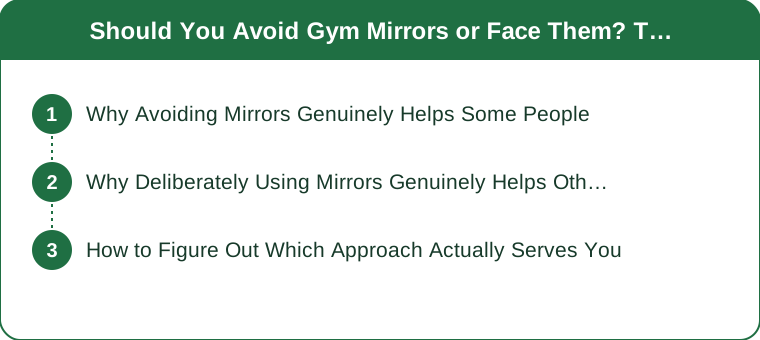
Why Does Avoiding Mirrors Help Some People?
It cuts off a comparison spiral before it starts. For some people, catching their reflection mid-set doesn’t produce information — it produces a critique. Then a comparison to the person behind them. Then a running commentary that lasts the rest of the workout. Whatever benefit the session was going to deliver psychologically gets eaten by that.
It lowers the barrier to actually showing up. Gym intimidation is real, and for a genuine subset of people, removing constant visual self-monitoring from the environment is enough to make attending sustainable. A workout you’ll do in a mirror-free corner beats a better workout you skip.
It can improve your form. This one surprises people, because it sounds like a consolation prize and isn’t. Shifting attention from how it looks to how it feels — where the tension is, which side is working harder, whether your ribs are flared — often produces better movement quality and better mind-muscle connection than watching yourself does. That’s a performance argument, entirely separate from the emotional one.

Why Does Using Mirrors Help Other People?
Real-time form feedback, with real safety stakes. On a barbell squat, an overhead press, or a hip hinge, a mirror catches things your internal sense misses — knees caving, one shoulder riding high, a back rounding under load. These are exercises where poor form has actual injury consequences. Avoiding mirrors during them means giving up genuinely useful information.
Repeated neutral exposure can shift body image over time. For some people, seeing themselves regularly in a context where their body is doing something competent gradually moves the relationship toward neutrality. Not “loving what you see” — just seeing it without the volume turned up. It works for some people and not others, and there’s no way to know which you are without trying.
Visible progress is a real motivator. Posture improving, form getting cleaner, a movement that used to wobble now looking solid. For people who find visual confirmation meaningful, that’s a legitimate feedback loop that sustains a habit. Dismissing it as vanity is its own kind of overconfidence.
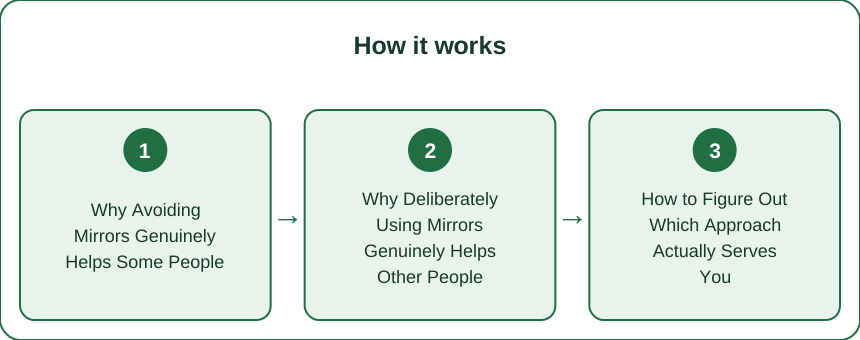
What Nobody Tells You About Picking a Side
Notice your actual reaction, not the one you think you should have. This is the whole method. Spend two weeks paying attention: when you catch your reflection mid-set, what happens in the next ten seconds? Useful adjustment, or a spiral? Don’t decide in advance which answer is the healthy one. Just observe what actually occurs.
The right answer probably varies by exercise. This is the insight both camps miss. Mirrors are genuinely useful for a squat and genuinely useless on an elliptical. A hybrid — mirror on for form-critical lifts, positioned away for cardio and accessory work — fits most people better than either absolute rule. Most gyms have both zones. Use both.
It can change, and that’s not backsliding. A strategy that was right during a rough patch with body image may not be right two years later, and vice versa. Reassess every few months. Neither approach is a permanent identity you have to defend.
Your experience beats both camps’ confident prescriptions. “Always avoid mirrors” and “always face them” are both general rules stated with more certainty than individual variation supports. You have direct access to data neither camp has: what actually happens to you.
One small practical note on the hybrid approach — if part of what makes the mirror uncomfortable is fabric going sheer at the bottom of a squat, that’s a solvable problem rather than a body problem. A pair of genuinely squat-proof high waist leggings removes one real variable from the equation.
Mini FAQ
Is it weird to face away from the mirror at the gym?
No, and nobody notices. Plenty of experienced lifters position themselves away from mirrors deliberately — some to avoid distraction, some because it’s the only free rack. Nobody is tracking your orientation.
What if I don’t have a choice — my gym is all mirrors?
Position matters more than presence. Facing a mirror is different from having one in your peripheral vision. Angle yourself so it’s off to the side, or use it only when you deliberately look up between sets.
When should I talk to someone about this?
If thoughts about your reflection are intense enough to affect eating, whether you go out, or how you spend your day — or if you find yourself checking mirrors compulsively or avoiding all reflective surfaces — that’s worth raising with a therapist. Body dysmorphia and eating disorders are treatable, and a mirror strategy isn’t the right tool for either.
TL;DR:
- Both avoiding and using gym mirrors are legitimate — they solve different problems.
- Avoid if reflection triggers comparison; internal focus can also genuinely improve form.
- Use if you want form feedback on injury-prone lifts, or want neutral exposure over time.
- Best default: hybrid — mirrors on for squats and presses, off for cardio and accessories.
- Watch your actual reaction for two weeks, reassess periodically, and see a therapist if it’s affecting daily life.
See It in Motion
Seen here: High Waist Yoga Leggings with Side Pockets — shop it on bubblelime.com
Keep Reading
This article is for general informational purposes only and is not medical advice. It is not a substitute for professional diagnosis or treatment. Always consult a qualified healthcare provider about your individual situation, especially before making significant changes to your diet or exercise routine.