How to Start Exercising Again After a Long Gap
Quick Answer: Start at roughly half of what you remember being able to do, and hold there for two full weeks before increasing anything. The single biggest risk on a restart is that your cardiovascular fitness and your motivation return faster than your tendons and connective tissue, which adapt over months rather than weeks. Frequency first, then duration, then intensity — in that order.
The restart problem is genuinely different from the beginner problem, because you know what the movements feel like and your body no longer matches the memory.
This is general information, not medical advice.

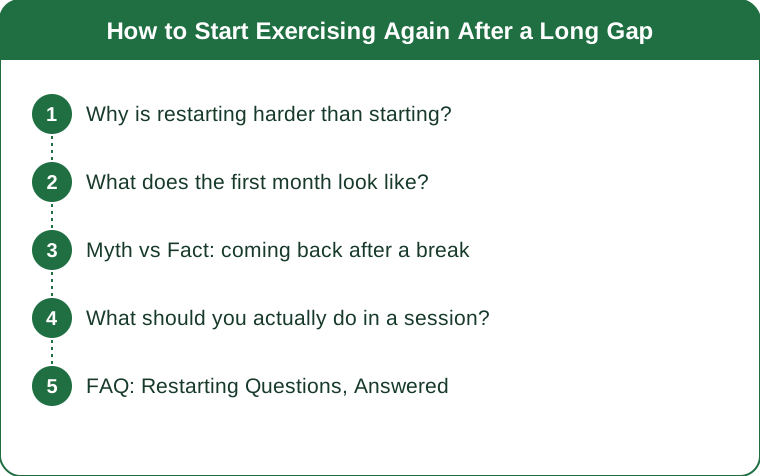
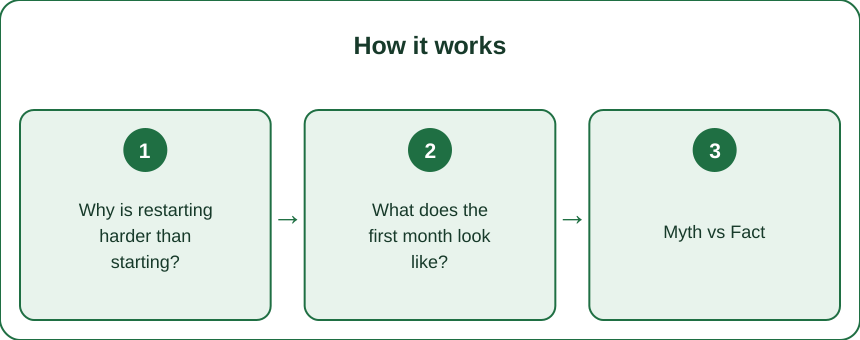
Why is restarting harder than starting?
Because the feedback you are getting is misleading in a specific way.
Motor patterns return almost immediately. You remember how to squat, how to run, how to hold a plank. That skill is durable and it comes back within a session or two, which makes it feel like everything else has come back too.
Cardiovascular fitness returns fast. Meaningful aerobic adaptation reappears within two to four weeks of consistent training after a layoff — considerably faster than it was built the first time.
Muscle returns fast too, thanks to muscle memory at the cellular level. Regaining previously-held muscle is markedly quicker than gaining it initially.
Tendons, ligaments, and joint tissue do not. Connective tissue has poor blood supply and adapts on a timescale of months, not weeks. This is the mismatch that causes almost every restart injury: your heart and lungs and muscles say yes, your tendons have not been consulted, and Achilles, patellar tendon, and shoulder problems appear in weeks four to eight.
And your reference point is wrong. A beginner has no idea what they should be able to do, so they start conservatively. A returner has a vivid memory of a former capacity, and that memory is the single most dangerous input in the whole process.
What does the first month look like?
Specific and deliberately unambitious.
Weeks 1-2: establish frequency at half intensity.
Three sessions a week, each around 50% of what you remember being able to do. If you used to run five miles, run two. If you used to squat 60kg, do 30. The goal is not stimulus; it is showing up and letting connective tissue register that this is happening again.
You will feel like you are wasting your time. That feeling is the point — it is what stops you doing the thing that ends the restart in week five.
Weeks 3-4: hold intensity, add a little duration.
Same three sessions, same intensity, 10-15% longer. Still not heavier, still not faster. If soreness from weeks one and two was significant, stay flat rather than adding anything.
Week 5 onwards: increase one variable at a time, by about 10% a week.
Add load or add distance, not both. The 10% rule is imperfect but it is a reasonable guardrail and it exists because of exactly the tissue-adaptation lag described above.
Throughout: prioritise consistency over any individual session. Three moderate sessions a week for eight weeks beats two brilliant weeks followed by six weeks off, which is the pattern almost every failed restart follows.

Myth vs Fact: coming back after a break
Myth: You have lost everything and are starting from zero. Fact: You are not. Motor skill, muscle memory, and training knowledge all persist. Detraining is real but it is not a reset — returners progress substantially faster than true beginners, which is genuinely good news.
Myth: You should push hard early to make up for lost time. Fact: This is the single most common way a restart ends. The limiting factor is connective tissue adaptation, and that cannot be accelerated by effort. Pushing harder does not make tendons adapt faster; it makes them fail sooner.
Myth: Soreness means it is working. Fact: On a restart, significant soreness mostly means the stimulus was too novel too fast. Mild soreness is fine. Soreness that changes how you move for three days means the last session was too much.
Myth: You need a perfect programme before you begin. Fact: Programme quality matters far less than adherence in the first two months. A mediocre plan done three times a week beats an excellent plan done twice and abandoned.
Myth: If you cannot do what you used to, there is no point. Fact: This belief ends more restarts than any physical factor. The comparison that matters is to last week, not to a version of yourself from three years ago who also had different circumstances, different sleep, and a different life.
What should you actually do in a session?
Structure over specifics, because the specifics matter less than people think at this stage.
Warm up longer than you used to. Ten minutes, not three. Tissue that has been inactive needs more time to become compliant, and the warm-up is where the injury prevention actually happens.
Favour full-body sessions over splits. Three full-body sessions a week gives each movement pattern three exposures, which drives skill and tissue adaptation better than one exposure each in a four-way split.
Compound movements, moderate loads, submaximal reps. Squat, hinge, push, pull, carry. Leave two or three reps in reserve on every set — this is not the phase for training to failure.
Include something for tendons deliberately. Slow, controlled eccentrics — three seconds lowering — are well evidenced for tendon adaptation and are exactly what a restart needs. Calf raises, slow squats, controlled rows.
Add walking. Unglamorous, and it builds the aerobic base and tissue tolerance with almost no injury risk. Twenty to thirty minutes on non-training days does more for a restart than a fourth gym session.
Late summer note: the weather is still warm enough that outdoor sessions are easy to start now, and the window closes in about six weeks. Building the habit while it is pleasant means it is established before the weather makes it hard. This is general information, not medical advice — if you have a specific injury history or a health condition, get advice specific to you before restarting.
FAQ: Restarting Questions, Answered
How long until I feel like myself again?
Most people report feeling substantially better within three to four weeks, and reaching something near a previous capacity within two to four months depending on the length of the gap. The subjective improvement arrives well before the numbers do.
Should I weigh myself or track measurements?
Only if it helps you. On a restart, early body composition changes are slow and inconsistent while fitness changes are fast, so tracking weight tends to produce discouragement at exactly the wrong moment. Tracking sessions completed is a better early metric.
What if I keep restarting and stopping?
That pattern usually means the plan was too demanding rather than that you lack discipline. Cut the target in half — two twenty-minute sessions a week — and hold it for a month. A plan you can keep during a bad week is the only kind that survives, and a bad week always arrives.
TL;DR:
- Start at about half of what you remember, and hold there for two full weeks before adding anything.
- Motor skill, cardio, and muscle come back fast; tendons and ligaments adapt over months — that mismatch causes most restart injuries.
- Frequency first, then duration, then intensity, increasing one variable by about 10% a week.
- Warm up for ten minutes, favour full-body sessions, leave reps in reserve, and include slow eccentrics for tendons.
- Add walking on off days, and measure sessions completed rather than weight.
The memory of your old capacity is the most dangerous input on a restart. Compare to last week instead. This is general information, not medical advice.
See It in Motion
Seen here: Racerback Tank Top - White — shop it on bubblelime.com
Keep Reading
This article is for general informational purposes only and is not medical advice. It is not a substitute for professional diagnosis or treatment. Always consult a qualified healthcare provider about your individual situation, especially before making significant changes to your diet or exercise routine.