What Actually Happens When You Ask a Trainer for Help
Quick Answer: Asking a floor trainer how a machine works takes about 60 to 90 seconds, is part of their actual job description, and happens to them many times a day from people at every level. They will not ask about your goals, judge your weight selection, or remember it an hour later. The single sentence that works is: excuse me, can you show me how to set this one up? - and it works because it is specific, brief, and easy to answer.
You have walked past the same machine for three weeks. The reason is not that you cannot figure it out. It is that figuring it out in front of people feels worse than not using it.

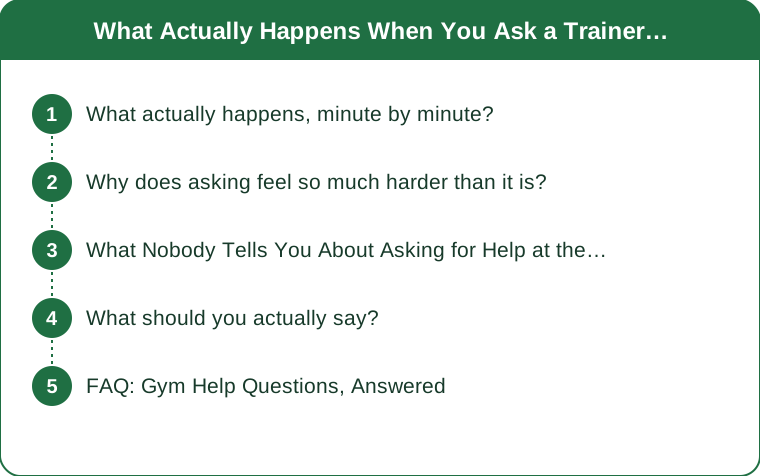
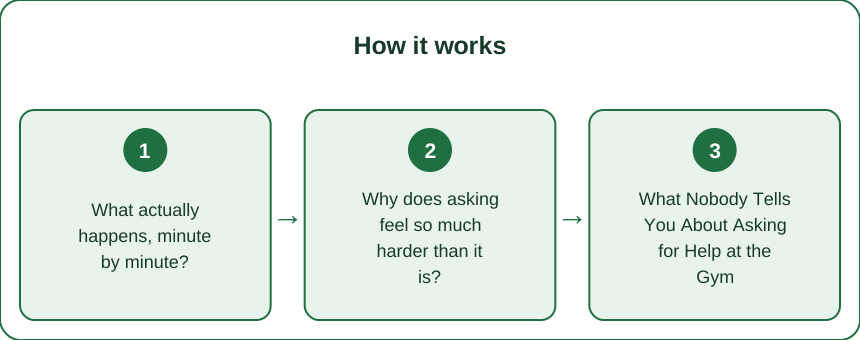
What actually happens, minute by minute?
Concretely, because the imagined version is far more elaborate than the real one.
You ask. They walk over. Floor staff at most gyms are explicitly there for this - it is why they are on the floor rather than in an office. At many gyms it is a measured part of the role, and unanswered questions on the floor look worse for them than for you.
They adjust the seat and show you the movement. Usually twenty seconds of demonstration, then they watch one or two repetitions.
They give you one cue. Something like keep your back against the pad, or do not lock out at the top. One cue, not a lecture.
They ask if that makes sense, and they leave. Total elapsed time: about a minute and a half.
What does not happen: they do not ask what you are training for, comment on the weight you chose, suggest you start somewhere easier, or bring it up later. The interaction is genuinely unremarkable to them, which is the part that is hard to believe from the outside and is true anyway.
The one exception: at some gyms, staff are expected to mention personal training. If that comes up, no thanks, just needed the setup ends it, and that is a completely normal thing to say.
Why does asking feel so much harder than it is?
Because of a specific and well-documented gap between how much attention we think we receive and how much we actually receive.
People substantially overestimate how much others notice them. The gap between imagined and actual attention is large and consistent, and a gym - full of people focused on their own sets, their own counts, and their own phones - is close to a worst case for the illusion.
Asking feels like an admission. The internal framing is I do not know how to do this, which feels like it reveals something. The external reading is simply a person asking a question, which observers process in about a second and forget.
Unfamiliar environments amplify it. Gyms have their own norms, equipment, and unwritten etiquette, and unfamiliarity makes everything feel more observed. This fades with exposure faster than people expect - usually within a handful of visits.
And the avoidance compounds. Skipping the machine means it stays unfamiliar, which makes asking next week feel harder than it would have this week. The cost of not asking is the only part of this that actually accumulates.

What Nobody Tells You About Asking for Help at the Gym
Experienced lifters ask too. They ask about unfamiliar machines, about whether a piece of equipment is free, about how a new attachment works. Asking is not a beginner behavior - it is what people do around unfamiliar equipment at any level.
Staff prefer being asked to watching bad setup. From their side, someone using a machine with the seat at the wrong height is a problem they will eventually have to address anyway. The question is easier for everyone.
The busiest time is the worst time to ask. Between about 5 and 7pm, floor staff are stretched. Mid-morning, early afternoon, or late evening get you a more relaxed answer and a less crowded machine to practice on.
Machines often have instructions printed on them. Many have a diagram on the frame showing the movement and the muscles. Reading it first is completely fine and answers the question maybe half the time.
One question can cover several machines. Since I have you - is this one similar? gets you two or three for the price of one, and staff generally do not mind at all.
Nobody remembers. The gym is full of people whose attention is entirely occupied by their own workout, their own rest timer, and their own discomfort. This is genuinely the most reassuring fact available, and it holds up every time.
What should you actually say?
Short, specific, and easy to answer - which is what makes it comfortable for both people.
The default line: excuse me, can you show me how to set this one up? Specific and bounded. It asks for a setup, not a lesson, so both of you know what a complete answer looks like.
If you want form checked too: could you watch one rep and tell me if I am doing it right? Also bounded, and the most valuable ninety seconds available in a gym.
If nobody is on the floor: ask at the front desk. They will either help or radio someone. This is entirely normal and it is what the desk is for.
If you would rather not ask a person at all: search the machine’s name plus setup on your phone. It works, and there is nothing wrong with it. It is just slower than the ninety-second version, and it does not catch the thing a person would notice about your specific setup.
And if the answer was rushed or unhelpful, that is about their day, not about you. Ask a different staff member another time. A gym where staff are consistently dismissive is a gym worth leaving, and that is information about the gym rather than about whether you belong in one.
FAQ: Gym Help Questions, Answered
Do I need to book a session to get help with a machine?
No. Floor questions are free at essentially every gym. Booked sessions are for programming and sustained coaching, not for showing you how a seat adjusts.
What if I forget what they told me by next week?
Completely normal, and you can ask again. Taking ten seconds to note the seat setting and pin position in your phone means you will not have to - and setting numbers are the part people actually forget, not the movement.
Is it rude to ask someone using the machine rather than staff?
Most people are happy to help between sets, but wait until they finish a set, keep it brief, and read the room - headphones in and eyes down means ask someone else. Staff are the safer default.
What if the gym has no floor staff?
Some budget gyms operate that way. In that case, the machine diagram plus a video search is the route, and going at a quieter hour makes practicing the setup far more comfortable.
This is general information, not medical advice - if you have an injury or a health condition, check with a professional before starting new equipment.
TL;DR:
- Asking a floor trainer takes 60 to 90 seconds, is part of their job, and is genuinely unremarkable to them.
- The gap between how much attention you think you get and how much you actually get is large, and a gym is close to the worst case for that illusion.
- Use one specific, bounded line: can you show me how to set this one up?
- Ask mid-morning or late evening rather than at 6pm, and note the seat and pin settings in your phone afterward.
The machine you have been walking past for three weeks costs you nothing to keep avoiding, which is exactly why it keeps happening. Ninety seconds of mild awkwardness buys you a piece of equipment you can then use for years, and by tomorrow you will be the only person who remembers the conversation happened.
See It in Motion
Seen here: High Waist Yoga Leggings with Inner Pocket — shop it on bubblelime.com
Keep Reading
This article is for general informational purposes only and is not medical advice. It is not a substitute for professional diagnosis or treatment. Always consult a qualified healthcare provider about your individual situation, especially before making significant changes to your diet or exercise routine.