What Body Positive Movement Actually Means When You Are the One Moving
Quick Answer: Body positive movement means choosing and structuring exercise around what your body can do and how it feels, rather than around changing how it looks. In practice it changes four concrete things: the goals you set, the metrics you track, the language you use in your own head, and the environments you train in. It is not the same as abandoning progress — most people who make the switch train more consistently, not less.
The phrase turns up on leggings, on class descriptions, and in captions under photographs of people who look like they have never doubted a room in their lives. It has been used so loosely that it is fair to ask whether it means anything at the level where it matters — a Tuesday, a gym floor, a body that is tired.
It does. It just describes a set of decisions rather than a feeling.

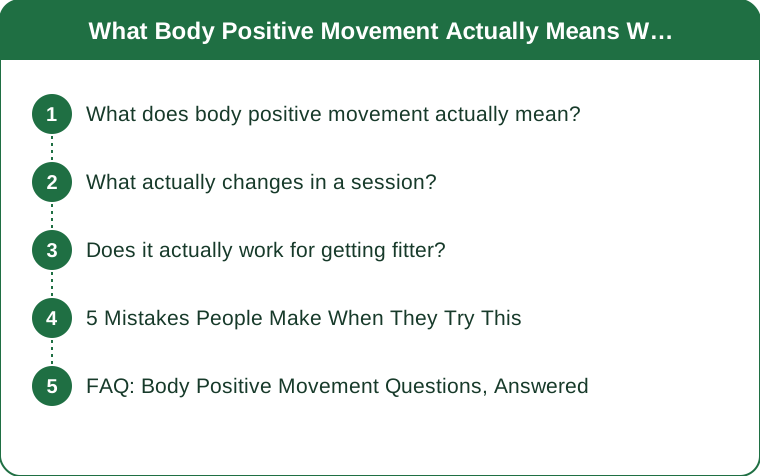
What does body positive movement actually mean?
It means the purpose of the session is capability and experience, not appearance change.
That is the entire definition, and everything else follows from it. It is worth being precise, because the term is regularly confused with three things it is not.
It is not the claim that everyone loves their body. Most people who train this way describe something closer to neutrality — the body is the thing you live in and move with, and it does not have to be an ongoing project or a source of feeling. Body neutrality is arguably the more accurate term for what most people actually practice.
It is not an argument against effort. Body positive movement includes progressive overload, hard intervals, and being sore. The distinction is what the effort is aimed at. Adding fifteen pounds to a deadlift because you want to be strong at sixty is effort in service of capability. The same fifteen pounds added because you are trying to change the shape of a thigh is the same physical act with a different governing logic, and the second one has a much worse retention rate.
It is not only for people who are not thin. The pattern of exercising to punish or correct a body cuts across every size, and so does the alternative.
The useful test is a question: if your body looked exactly the same in a year, would you still do this? If the honest answer is no, the movement is currently in service of appearance. That is not a moral failure — it is just useful to know, because it predicts what happens when the appearance change does not arrive on schedule.
What actually changes in a session?
Four specific things, all of them observable.
The goal changes from an outcome to a capability. Not a weight, a shape, or a size — a thing you can do. Walk the hill without stopping. Carry both bags up in one trip. Get off the floor without a hand. Hold a plank for ninety seconds. These are measurable, they improve reliably with training, and they do not depend on anything your body is not willing to do.
The metrics change. You stop weighing daily and start tracking reps, distances, how many flights before you notice, how you slept, and how many sessions you did this month. The last one is the strongest predictor of everything else and almost nobody tracks it.
The internal language changes. This sounds soft and is not. The person who thinks I have to earn this weekend is running a transactional model where exercise is a payment and food is a debt, and that model reliably produces both bingeing and skipped sessions. The person who thinks I train because I like being strong has removed the accounting entirely. Watch what you say in your own head during the last two reps; that is the model you are actually running.
The environment changes. Where you train and who is around you is not a soft factor. Mirrored front rows, classes that open with a comment about summer bodies, and apps that lead with a calorie deficit all reinforce the appearance frame whether or not you agree with it. Changing gyms or changing the class you go to is often the highest-leverage single move available, and it is the one people treat as a last resort.

Does it actually work for getting fitter?
The evidence is better than the tone of the conversation suggests.
The most consistent finding in exercise adherence research is not about programs. It is that enjoyment and autonomy predict long-term adherence better than any programming variable, and that adherence predicts outcomes better than program quality. A mediocre program you do for three years beats an optimal one you quit in six weeks, and that is not close.
Appearance-based motivation performs badly on exactly this axis. It is highly effective at getting someone to start, and poor at keeping them going — because the feedback is slow, noisy, and largely outside your control, and because when the appearance goal is met the reason to continue disappears. The well-documented pattern of intense January adherence followed by near-total dropout by March is this mechanism operating at scale.
Capability-based motivation has the opposite profile. The feedback is fast — you can add a rep this week — it is unambiguous, and it never runs out, because there is always a next thing to be able to do.
None of this means appearance change does not happen. It frequently does, as a side effect of the consistency. The distinction is which one is the steering wheel and which one is a passenger, and that distinction turns out to determine whether you are still doing this in two years.
There is one more practical benefit worth naming: capability goals survive bad weeks. A week where you sleep badly and eat unremarkably does nothing to a goal of walking the hill without stopping. It can completely derail a goal built on a number on a scale, and derailment is where most people stop.
5 Mistakes People Make When They Try This
1. Treating it as a rule against ever wanting to look different. You are allowed to want that. The mistake is making it the organizing principle of the training, because it is the one variable in the system you have least direct control over. Wanting it and not steering by it are compatible positions.
2. Swapping the goal but keeping the metrics. People decide to train for strength and then keep weighing themselves every morning. The daily weight is a loud, noisy signal, and it will re-anchor the whole thing within about two weeks no matter what you have decided intellectually. Change what you measure or nothing changes.
3. Assuming it means going easy. The rebound version of appearance-driven training is often no training. Body positive movement is not less demanding, it is differently aimed. Some of the most physically hard training happens under this frame precisely because there is no rush and no deadline.
4. Doing it alone in a hostile environment. Sustaining a capability frame in a gym where every screen and poster is running an appearance frame is possible and expensive. Most people underestimate how much of their self-talk is ambient rather than generated. Change the room.
5. Waiting to feel it before doing it. The feeling follows the practice, not the reverse. Nobody arrives at neutrality by reasoning their way there. It arrives after a few months of showing up and noticing that you can do things you could not do — which is why the third mistake matters more than it looks.
FAQ: Body Positive Movement Questions, Answered
Is body positivity the same as body neutrality?
Not quite. Body positivity, as a movement, originated in fat liberation activism and is about the right to exist in and be treated well in the body you have. Body neutrality is the narrower personal practice of not requiring yourself to have strong feelings about your appearance either way. In a fitness context most people are practicing neutrality and using the more familiar phrase.
What if I genuinely want to lose weight?
Then you are allowed to, and it is worth separating the two systems rather than merging them. Train for capability, handle nutrition separately, and do not let a slow week in one contaminate the other. The people who struggle most are the ones who have wired the two together so tightly that one bad meal cancels a workout.
How do I find a gym that is not going to work against this?
Look at their marketing rather than their equipment. If the transformation photo is the main product, you know what the room is organized around. Community gyms, strength-focused gyms, and anywhere with a masters or over-fifties program tend to run a capability frame by default. Going at a different hour changes the room more than people expect.
Is September a bad time to start, with all the back-to-normal messaging?
It is actually one of the better ones. The rooms are full of people restarting, which makes a beginner considerably less conspicuous than in a quiet month — and everyone else is too preoccupied with their own first week to be watching yours.
TL;DR:
- Body positive movement means training is aimed at capability and experience rather than at changing how you look.
- In practice it changes four things: your goals, your metrics, your self-talk, and where you train.
- Capability goals give fast, controllable feedback, which is why they survive bad weeks and appearance goals often do not.
- It does not mean easy — plenty of hard training happens under this frame, just without a deadline.
- Change what you measure, or the old frame will quietly reassert itself within a fortnight.
If you want one concrete first step: pick a thing you cannot currently do, write it down, and track sessions instead of anything else for a month. That single swap does more than any amount of deciding to feel differently about a mirror.
See It in Motion
Seen here: Super High Waist Embossed Yoga Leggings with Inner Pocket — shop it on bubblelime.com
Keep Reading
This article is for general informational purposes only and is not medical advice. It is not a substitute for professional diagnosis or treatment. Always consult a qualified healthcare provider about your individual situation, especially before making significant changes to your diet or exercise routine.