What Changes When You Stop Treating Exercise as a Project
Quick Answer: Treating exercise as a project sets you up to quit, because projects have completion criteria and bodies do not. The project frame produces intense starts, a defined endpoint, and a collapse when the endpoint arrives or is missed. The practice frame asks a smaller question - what does this week look like - and it survives the weeks that go badly. In practice this means abandoning start dates, twelve-week plans as identity, and the idea that a missed week undoes anything.
You have started before. Properly, with a plan and a start date and everything laid out.
And then something happened in week five and the whole thing evaporated.
That is not a willpower story. It is what the project frame does.

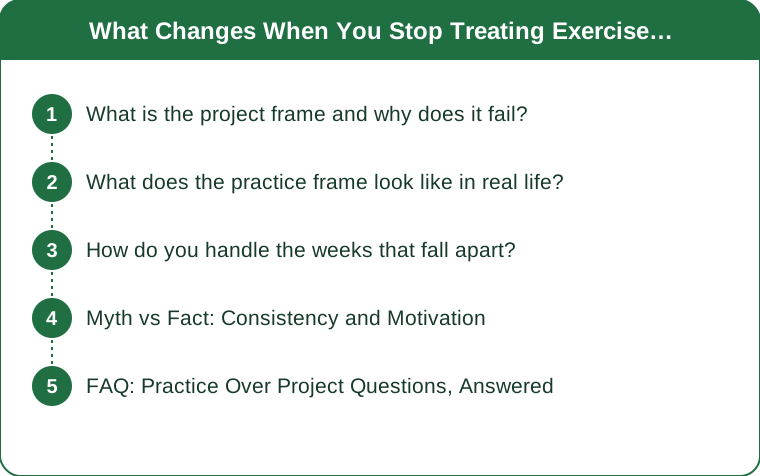
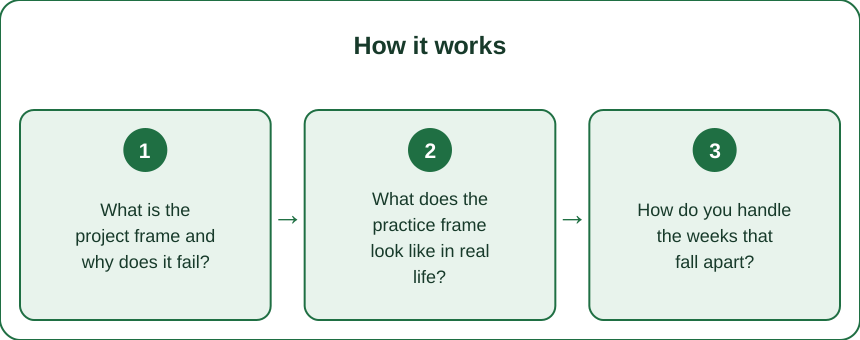
What is the project frame and why does it fail?
It is treating movement as something with a beginning, a middle and a finish.
A project has a defined scope, a deadline and a completion state. Twelve-week programme, event to train for, target weight, a date the transformation is due. The structure is genuinely motivating, which is why it works at the start.
The problem is what happens at the edges. Projects have two exits and both of them end the behaviour. You finish, and there is nothing after the finish. Or you fall behind, and a project that is behind schedule feels failed rather than paused.
The second exit is the common one. A missed week in a twelve-week plan is not a missed week - it is being off-plan, and the plan has no mechanism for continuing from off-plan. So people restart from the beginning, which they have already done, or they stop.
There is a subtler cost too. Projects require intensity to hit the deadline, which means the version of training you build is one calibrated for a temporary push. When the push ends, you have no idea what the sustainable version looks like because you never practised it.
And the finish itself is a problem. The week after a goal event or a completed programme is one of the most common points at which people stop entirely - not from lack of motivation, but because the structure that was carrying the behaviour has ended and nothing replaced it.
None of this means plans are bad. A twelve-week plan inside a practice is useful. A twelve-week plan as the whole relationship with movement is fragile by design.
What does the practice frame look like in real life?
Smaller questions, and no finish line.
The core question changes from what am I working toward to what does a normal week look like. A normal week is the unit, not a twelve-week block, and it is allowed to be unimpressive.
Concretely, that means:
- A minimum that is genuinely minimal. Something you would still do on your worst week - two sessions, or three walks. The minimum is the practice; everything above it is a bonus
- No start date. Starting on Monday, or on the first of the month, is project thinking. A practice starts whenever you next move
- Off weeks are part of the pattern, not a break from it. A week with one session is a low week in a continuing practice rather than a failure of a plan
- No completion state. The question is never am I done, it is what is this week
What this looks like when things go wrong is the real test. In a project frame, a week away from training creates a gap that has to be recovered. In a practice frame, you do the next session. There is nothing to recover because nothing was scheduled to be missed.
On goals, since this gets misread: goals are fine inside a practice. Training for a specific event is enjoyable and useful. The difference is that the practice continues after the event, at a lower intensity, without a decision needing to be made.
A useful test of which frame you are in: ask what happens the week after your current plan ends. If the honest answer is nothing planned, you are in a project.

How do you handle the weeks that fall apart?
Have a version of the week that survives them, decided in advance.
The most useful single thing is a defined floor. Not an aspiration - a specific, small, boring minimum you commit to on bad weeks. Two twenty-minute sessions. Or a daily ten-minute walk. Something you can do while ill-slept, busy and unmotivated.
The floor works because it removes the decision. On a difficult week the question is not whether to do the full programme - it is whether to do the floor, and the floor is small enough that the answer is usually yes.
Three things that make the floor actually function:
- It has to be embarrassingly small. If your floor feels like a real workout, it is too big for a bad week and you will skip it
- It has to be specific. Move more is not a floor. Two ten-minute walks is a floor
- It has to be pre-decided. Choosing the floor during a bad week does not work, because the bad week is exactly when the decision is hardest
What to do about a week that went to zero anyway: do the next session. That is the whole protocol. No make-up sessions, no starting again, no assessment of what went wrong. The single most common way people turn a bad week into a bad three months is treating the bad week as meaningful.
One reframe that helps more than it should: a year with forty good weeks and twelve bad ones is an excellent year. In a project frame those twelve weeks are twelve failures. In a practice frame they are the normal texture of a year, and the forty are what count.
Myth vs Fact: Consistency and Motivation
Myth: You need motivation to be consistent. Fact: Consistency mostly comes from lowering the activation cost - fixed times, laid-out kit, a small floor. Motivation shows up more often when the behaviour is already happening than the other way round.
Myth: Starting over means you lost everything. Fact: Detraining is real and slower than people fear, and previous training makes regaining substantially faster than building it the first time. You are not back at zero, and you have never been.
Myth: A structured programme is the serious option and everything else is casual. Fact: The most effective training is the training that continues. A modest routine sustained for two years outperforms three intense twelve-week blocks separated by nothing.
Myth: If you cannot do the full session there is no point. Fact: Partial sessions maintain the habit, maintain some of the adaptation, and keep the identity intact. Fifteen minutes is enormously more valuable than zero, and the gap between them is where consistency lives.
Myth: You should feel like you are progressing every week. Fact: Progress in any long practice is lumpy and includes flat stretches. Expecting weekly progress is a project expectation applied to something that does not work that way.
Myth: The right plan will fix consistency. Fact: Plan quality is a small factor compared with whether the plan fits the life around it. Most abandoned plans were good plans attached to an unrealistic week.
FAQ: Practice Over Project Questions, Answered
Does this mean I should not follow a programme?
Not at all - programmes are useful and following one is fine. The change is that the programme sits inside an ongoing practice rather than being the whole thing, so that when it ends or gets disrupted, movement continues at a lower level.
How small should my minimum actually be?
Small enough that you would do it on your worst week without negotiating. For most people that is two short sessions or a daily short walk. If it feels like a real workout, it is too big to function as a floor.
I have restarted five times. Is that a bad sign?
It means the project frame has been failing you five times, which is information about the frame rather than about you. Restarting repeatedly is the predictable output of a structure with only two exits.
What about training for a specific event?
Good reason to train, and worth doing. The thing to decide in advance is what the week after the event looks like, because the week after is where most people stop.
How long until this feels normal?
Usually a few months, and the marker is not how it feels day to day. It is what happens after a disrupted week - if you resume without a decision, the practice has taken.
TL;DR:
- The project frame has only two exits - finish or fall behind - and both end the behaviour
- Practice asks what does this week look like, and survives weeks that go badly
- Define an embarrassingly small floor in advance; it removes the decision on hard weeks
- After a zero week, do the next session - no make-up, no restart, no analysis
- Plans and events are fine inside a practice; decide what the week after looks like before you get there
- Forty good weeks and twelve bad ones is an excellent year, not a failed one
Stop looking for the start date. The practice starts the next time you move.
See It in Motion
Seen here: High Waist Embossed Yoga Leggings with Side Pockets — shop it on bubblelime.com
Keep Reading
This article is for general informational purposes only and is not medical advice. It is not a substitute for professional diagnosis or treatment. Always consult a qualified healthcare provider about your individual situation, especially before making significant changes to your diet or exercise routine.