Why the Locker Room Is the Part Nobody Warns You About
Quick Answer: The locker room is harder than the gym floor for a specific structural reason - it is the one space in the building with no task to hide behind. On the floor you are doing something. In the locker room you are just existing near strangers. The practical fixes are arrive changed, claim a corner locker, have a fixed sequence so you are never standing still deciding, and keep the whole visit under four minutes. Nearly everyone finds it gets easier by about the fifth visit.
Every guide to starting at a gym talks about the equipment, the etiquette, and the first workout. Almost none of them mention that for a lot of people the hardest 90 seconds of the entire visit happen before they have touched a single machine.

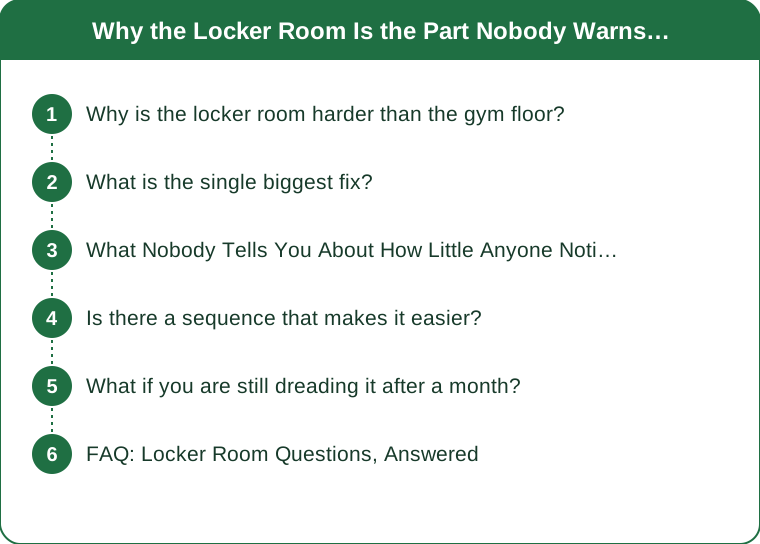
Why is the locker room harder than the gym floor?
It comes down to what psychologists call self-focused attention, and the locker room maximises it.
On the gym floor you have a task. You are counting reps, watching a timer, adjusting a seat. Attention pointed at a task is attention pointed away from yourself, and that is genuinely protective. The locker room removes the task. You are standing in a small room with strangers, doing something private, with nothing to look at and nothing to do with your hands.
It is also the only space where the social rules are unwritten and vary wildly. How much people change, how much they talk, whether anyone makes eye contact - all of it differs between gyms, and none of it is posted anywhere. Walking into a room where you do not know the norms is uncomfortable for almost everybody, and the discomfort is about the uncertainty rather than about your body.
The third factor is compression. The gym floor is large and spread out. A locker room is small, and proximity to strangers in a small space raises baseline arousal in a way that has nothing to do with confidence.
What is the single biggest fix?
Arrive already changed.
It sounds like avoidance and it is not - it is a completely normal thing that a large share of gym members do, and at many gyms it is the majority. Wear your kit, bring a small bag, use a locker for your keys and phone, and walk out onto the floor.
This turns a 6-minute exposure into a 40-second one, and it removes the specific part - undressing near strangers - that most people find hardest. It also means you have one fewer decision at the moment when your resolve is thinnest, which is walking through the door.
The obvious objection is showering. For most people, especially in the first month, the honest answer is: go home and shower there. A 15-minute drive home in gym clothes is a perfectly good trade for actually going. If your gym is on the way to work and showering there is non-negotiable, that is a different situation and the sequence below is the tool.
One caveat worth naming: arriving changed is a starting strategy, not a permanent rule. Most people find that after a few weeks the room stops registering at all and they change there without thinking about it.
What Nobody Tells You About How Little Anyone Notices
There is a well-documented gap between how much we think we are observed and how much we actually are - researchers call it the spotlight effect, and it is consistently large.
In locker rooms specifically, three things are working in your favour that nobody mentions.
Everyone is in a hurry. The average locker room visit is short and purposeful. People are late for a class, late for work, or wanting to leave. Nobody is browsing.
There is a strong, universal, unspoken norm of not looking. It is the most reliably observed etiquette in any gym, more reliable than wiping down equipment. People look at their locker, their bag, or the floor.
The people who look most confident are frequently the newest. Confidence in a locker room correlates with how many times you have been in that specific room, not with fitness or body type. The regular who breezes in is not braver than you - she has just done it 200 times and it has stopped being an event.
The practical version: the discomfort is real and it is also almost entirely internal. That is genuinely good news, because internal things respond to repetition.

Is there a sequence that makes it easier?
Yes, and having any fixed sequence helps more than which one you choose. Standing still while deciding is where the discomfort concentrates.
Pick your locker before you slow down. Corner and end-of-row lockers are less trafficked and give you a wall on one side. Choose it on the walk in rather than scanning the room.
Bag on the bench, open, facing you. This gives your hands a job immediately.
Change in a fixed order - shoes, bottoms, top, shoes. Same order every time. It becomes automatic within about three visits and automatic is the goal.
Use a towel or an oversized tee if you want a layer of privacy. This is completely normal and nobody registers it.
Lock, phone in pocket, leave. Do not stand at the mirror. The mirror is where a 90-second visit becomes a five-minute spiral.
Target: four minutes. Time it once, and you will usually find the real number is shorter than the one in your head.
What if you are still dreading it after a month?
Then change the variables rather than trying harder at the same thing.
Change the hour. Locker rooms have sharp peaks - typically 6-8am and 5-7pm on weekdays. A visit at 10am or 2pm is often a nearly empty room. If your schedule allows even one off-peak session a week, do that one first.
Change the gym. Facilities vary enormously in layout. Some have individual changing cubicles as standard, some have a curtained area, some are one open room. This is a legitimate reason to choose a gym and worth asking about on a tour - and asking is completely unremarkable.
Change the format. A studio class, an outdoor bootcamp, or a pool with cubicles all bypass the issue entirely while you build the habit.
Consider whether it is the room or something else. If the dread is specific to the changing room and does not fade with repetition, or if it is part of a broader pattern of avoiding situations where your body might be seen, that is worth talking to someone about - a lot of people find it resolves quickly with the right support, and it is far more common than the silence around it suggests.
This is general information, not medical advice.
FAQ: Locker Room Questions, Answered
Is it rude to change in a toilet cubicle?
No. It is extremely common, nobody notices, and it is a perfectly good tool. The only etiquette point is not to occupy one for fifteen minutes at a peak hour.
Do people really not look?
The not-looking norm is close to universal in gym changing rooms. The exception is that people do sometimes look at what you are wearing - a bag, a jacket, shoes. That is curiosity about the object, not about you.
How long until it stops being uncomfortable?
Most people report a clear drop after about five visits to the same room, and that it stops registering entirely somewhere around three or four weeks. Familiarity with the specific space is doing the work, which is an argument for going to the same gym at the same time while you settle in.
TL;DR:
- The locker room is hard because it is the one gym space with no task to hide behind - not because of you.
- Arrive already changed for the first few weeks. It is normal, and it cuts the exposure by 90%.
- Have a fixed sequence, take a corner locker, skip the mirror, and aim for four minutes.
- If it has not eased after a month, change the hour or the gym rather than trying to tough it out.
Nobody puts this in the beginner guides, which is a shame, because it is the part that actually stops people from going back. It is also the part that fades fastest once you have done it a handful of times.
See It in Motion
Seen here: High Waist Jogger Sweatpants with Pockets — shop it on bubblelime.com
Keep Reading
This article is for general informational purposes only and is not medical advice. It is not a substitute for professional diagnosis or treatment. Always consult a qualified healthcare provider about your individual situation, especially before making significant changes to your diet or exercise routine.