How to Find a Workout You Don't Secretly Hate
Quick Answer: To find a workout you don’t hate, stop shopping by calorie burn and start matching movement to what you already enjoy — music, being outside, calm, competition, or company. Try one new format a week for four weeks and keep only what you’d do on a bad day. The best workout is the one you’ll still be doing in six months.
If you dread every workout, force yourself through it, and quit by mid-February, you’re not lazy. You’ve been doing exercise you hate, and willpower has never once won that fight long-term.
Here’s the part nobody says out loud: there’s almost certainly a form of movement you’d genuinely enjoy, and you probably haven’t tried it yet because it doesn’t look “serious” enough to count.
Let’s go find it.

Why Does “Just Push Through” Stop Working?
Because willpower is a finite daily resource and dread burns through it fast.
Think about the math. A workout you hate costs you two things: the 45 minutes of the workout, and the two hours beforehand spent negotiating with yourself about it. A workout you like costs you 45 minutes. Over a month, the disliked version isn’t just harder — it’s ten hours more expensive in mental overhead.
That’s why adherence beats optimization every time. A “less effective” workout you do 4 times a week beats a perfect program you do twice a month, and it isn’t close. Three months of imperfect consistency outperforms three weeks of perfect intensity followed by nine weeks of nothing.
Your brain isn’t broken for wanting to skip. It’s doing exactly what it should when something feels like punishment.
What Kind of Movement Should I Actually Try?
Start from what you liked before fitness became a chore. The answer is usually sitting right there.
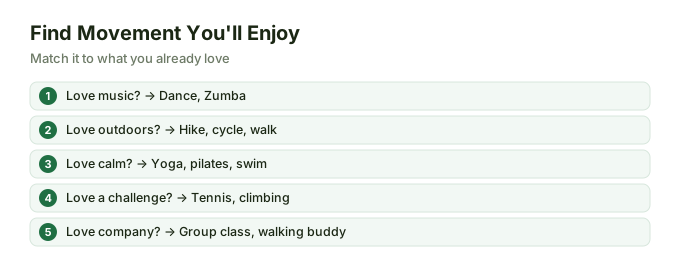
- Love music? Dance classes, Zumba, a cycling class built around a playlist, or honestly just a 30-minute walk with an album you love.
- Love being outside? Hiking, cycling, trail walking, kayaking, gardening that involves actual digging.
- Love calm and quiet? Yoga, Pilates, swimming laps, long stretching sessions, tai chi.
- Love a challenge or a game? Tennis, pickleball, climbing, martial arts, recreational league anything. Competition makes the time vanish.
- Love company? Group classes, a walking buddy, a run club. The social contract does the motivating for you.
- Love finishing things? Try a program with a defined endpoint — a couch-to-5K, a 30-day mobility challenge. Some brains run on completion, not enjoyment.
A 4-week test protocol: try one new format each week, one session each. Four sessions total. At the end, ask a single question about each: would I do this on a day I felt mediocre? Keep the yeses. That’s your list.
The 5 Beliefs That Keep People Stuck
- “It doesn’t count unless I’m sweating.” Walking counts. Stretching counts. A 20-minute swim counts. The body responds to accumulated movement, not to how dramatic it looked.
- “I should like what works best.” You don’t have to. Enjoyment isn’t a bonus feature of a good program — for most people it is the program, because it’s what produces the repetitions.
- “Quitting a class means I failed.” Trying five things and dropping four is not failure, it’s a search. That’s how the search is supposed to look.
- “I need to be good at it first.” Everyone in that beginner class was also terrible in week one. The instructor has seen worse than you, this morning.
- “Exercise is what I owe my body for what I ate.” This is the one that quietly poisons everything else on the list. Movement as penance never becomes a habit — it becomes a punishment you eventually stop administering.

How Do You Make It Stick Once You Find It?
Three things, none of them dramatic:
Lower the entry cost. Lay out clothes the night before. Keep sneakers by the door. Most skipped workouts are lost in the friction before the workout, not during it.
Anchor it to something existing. “After I drop the kids off” beats “sometime Tuesday.” A habit attached to an event you already reliably do inherits that event’s reliability.
Set the floor absurdly low. Your minimum should be something you’d do with a headache — 10 minutes, one class, one walk around the block. Consistency lives at the floor, not the ceiling. On good days you’ll do more anyway.
And one comfort: the goal isn’t to love every session. Even people who genuinely enjoy their training don’t want to go about a third of the time. They just have a floor low enough that showing up is easier than negotiating.
FAQ
How long until a workout stops feeling like a chore?
For most people it takes about 4–6 weeks of reasonably regular sessions before the early awkwardness fades and the movement itself starts feeling normal. If a specific format still feels like dread at week six, that’s real information — it’s probably not your format, and switching isn’t quitting.
Is walking enough to count as exercise?
Yes. Regular brisk walking meaningfully supports cardiovascular health, mood, and general fitness, and the widely cited public health guidance of roughly 150 minutes of moderate activity a week is fully achievable by walking alone. If you want more, add hills or pace rather than switching to something you’ll hate.
What if I’ve tried lots of things and hated all of them?
Two things worth checking. First, whether you tried them at genuinely beginner intensity — a lot of “I hate running” is really “I hate running at a pace I can’t sustain.” Second, whether context is the problem rather than the movement; the same exercise can feel completely different alone at home versus in a crowded class.
General wellness information, not medical advice. If you have a health condition, are pregnant, or are returning from injury, check with your doctor before starting something new.
TL;DR:
- Dread drains willpower faster than any workout drains your legs — adherence beats optimization
- Match movement to what you already enjoy: music, outdoors, calm, competition, or company
- Run a 4-week test: one new format per week, keep only what you’d do on a mediocre day
- Lower the entry cost, anchor it to an existing routine, and set a floor you could hit with a headache
- Walking counts. So does dancing, swimming, and playing. Accumulated movement is the point
See It in Motion
Seen here: Round Neck Long Sleeve Athletic T-Shirt — shop it on bubblelime.com
Keep Reading
This article is for general informational purposes only and is not medical advice. It is not a substitute for professional diagnosis or treatment. Always consult a qualified healthcare provider about your individual situation, especially before making significant changes to your diet or exercise routine.